


Introduction: Your Credit File Just Went Real-Time
Your credit report is updated monthly. Macro signals matter too; for instance, recent data shows revolving credit fell at a 1.9% credit drop annual rate, while today’s financial technology allows AI to re-score you in near real-time. In the fast-paced Texas housing market, maintaining a competitive edge requires more than just capital; it requires a deep understanding of how your credit score shapes your real estate journey.
[THE REAL-TIME SHIFT]
Positions the HNW client to act before “Data Drift” occurs by summarizing that behavioral shifts impact approvals in milliseconds.
What Really Changed? From Static Scores to Streaming AI Credit Profiles

[TRENDED DATA BENEFITS]
AI now leverages alternative data—including rent, utilities, and cash flow—to reward stable, consistent behavior. For sophisticated investors, this transparency rewards long-term financial stability with institutional-grade capital access.
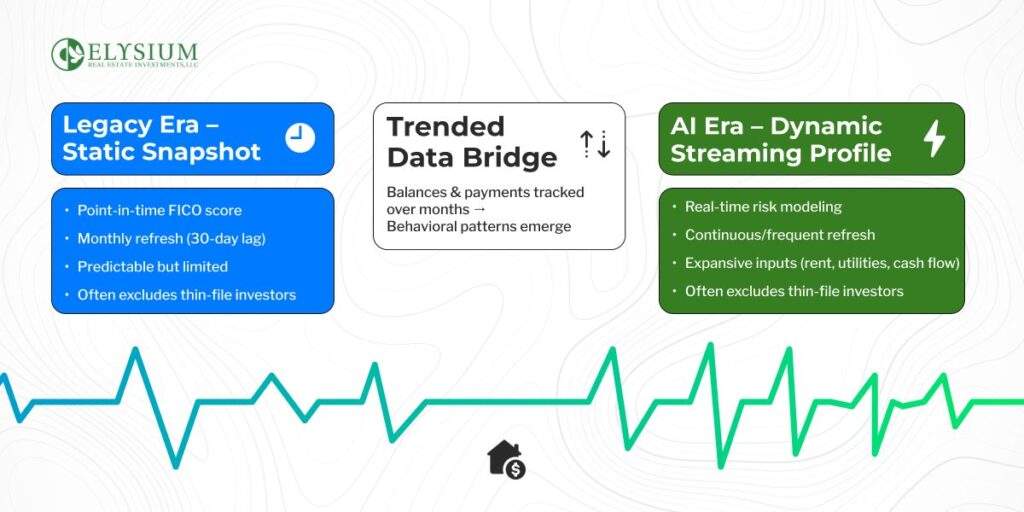
For Texas SFR deals, this means rising utilization or inquiry velocity can tighten your terms even if your property’s cash flow is stable. Lenders now use alternative data for credit scoring, such as rent and utility payment history, to create a granular risk profile that “streams” rather than “clicks.”
We know you value the ‘why’ behind the numbers. We invite you to a Technical Deep-Dive Zoom to look under the hood of current AI risk models and ensure your portfolio is built for long-term governance.
Why the "New Machine" is in Favor of AI?

AI is not just a denial machine. When your behavior is consistent, the artificial intelligence credit scoring models read you as “low friction”, rewarding you with speed and better pricing on DSCR loans. That is why building strong personal credit for Texas real estate is now about signaling stability to the algorithm.
For the High-Earning, Time-Poor Professional (HETP), a clean, machine-readable file removes the friction that often kills deals mid-escrow. According to Equifax, their machine-learning models help lenders find “credit-worthy” borrowers who might have been missed by traditional, rigid scoring. By maintaining a predictable profile, you unlock access to institutional-grade capital that moves as fast as the Texas market.
That upside matters because the baseline is shifting. Investopedia reported in June 2025 that the average FICO score dropped to 715 in April 2025 due to higher utilization and delinquencies.
In Texas, these models shape how lenders view DSCR loans, portfolio LOCs, and growing SFR portfolios. A small drift in utilization or clustered inquiries can tighten pricing or add conditions, even when rents cover the note. Treat timing as a strategy, so approvals stay smooth during fast-moving closings.
The Texas Market Context: The Approval Guardrail
In the Texas SFR and DSCR market, speed is the primary currency. Because AI models now refresh constantly, a sudden score drop caused by high inquiry velocity or a balance spike can kill a deal mid-escrow.
[THE APPROVAL GUARDRAIL]
A real-time score drop isn’t just a number; it’s a deal-killer. In the fast-moving Texas market, we act as your guardrail to ensure “Data Drift” doesn’t disrupt your acquisition timelines.
We know you value the “why” behind the numbers. We invite you to a Technical Deep-Dive Zoom to look under the hood of current AI risk models and ensure your portfolio is built for long-term governance.
How are Equifax, Experian, and TransUnion actually using machine learning?

Equifax, Experian, and TransUnion still anchor most underwriting. Your lender may overlay an internal model, yet bureau inputs remain the fuel. One practical anchor is this: chase lender-fit, not score vanity. The score that matters most is the one the lender uses for that specific decision.
To the AI, you are a data set. If your data is messy—meaning inconsistent addresses, mismatched names, or erratic inquiry patterns—the “Machine” flags you as high risk.
[THE MACHINE-READABLE GOAL]
Clean inputs lead to faster portfolio LOC approvals. By ensuring consistent addresses and paced inquiries, we remove the technical friction from your institutional-grade capital access.
Equifax – From Static Scores to ML-Driven OneScore
Experian – AI-Driven Decisioning at Scale
TransUnion – The Marriage of Trended and Alternative Data
TransUnion has pushed trended data and alternative inputs into modern mortgage scoring approaches. A 2025 TransUnion announcement highlights new mortgage credit offerings leveraging VantageScore 4.0 built on trending and alternative data.
That matters for Texas investors seeking repeat financing. A richer credit view can support access when you are scaling, especially if your profile shows stable behavior over time. This affects how active investors manage non-traditional data when securing financing for their Texas real estate strategy.
TransUnion’s focus on cash-flow patterns directly impacts how you manage non-traditional data when securing financing for a Texas real estate strategy. If rental or utility tradelines appear, gaps and inconsistencies can read like instability, even when the property performs well.
When you are building a Texas SFR portfolio, the cleanest approach is to keep payment timing steady and avoid stop-start patterns that create “choppy” signals. That steadiness can help protect pricing on repeat DSCR loans, and it can support smoother renewals on portfolio lines of credit when you need quick access to capital.
TransUnion specializes in weaving alternative data for credit scoring—such as checking account flows—into their risk modeling. This affects how active investors manage non-traditional data when securing financing for a complex Texas real estate strategy.
The Downside: New Risks in an AI Credit World
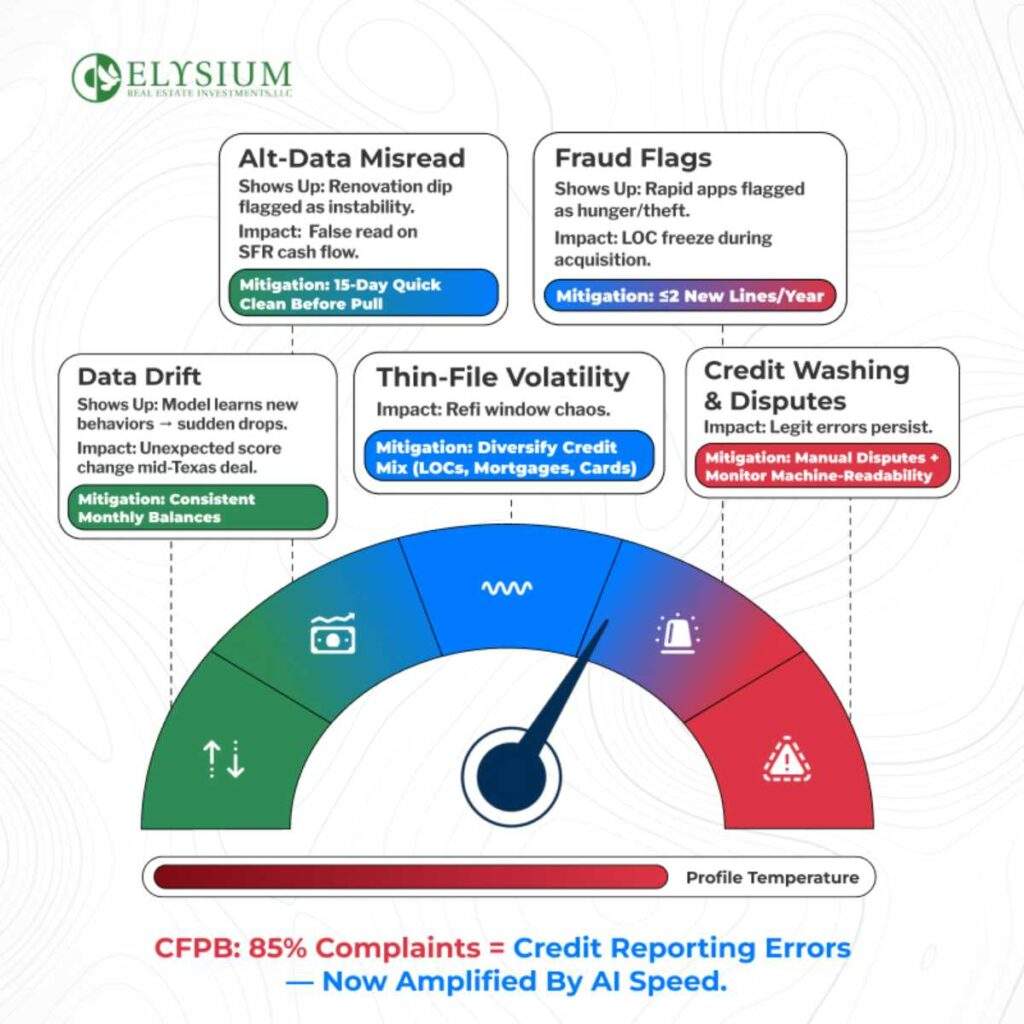
For the High-Earning, Time-Poor Professional, AI credit scoring can punish speed when applications stack too close together, turning a busy month into a surprise rate shock.
Higher sensitivity means small issues can echo. A reporting error can become a “risk signal” that raises pricing, slows underwriting, or triggers fraud protocols.
The CFPB’s annual complaint report notes that credit or consumer reporting complaints accounted for 85% of complaints received, illustrating that errors are now amplified by AI speed.
You handle the growth of your career; let us handle the friction of your financing. Reach out for a Friendly 20-Minute Strategy Call so we can act as your expert translator and simplify the approval process for you.
What This Means for Your Next Loan, Refi, or Credit Line
For DSCR loans, the property’s cash flow is central, yet your credit still shapes pricing and conditions. For the Data-Driven Investor, a small utilization drift across two cards can compress leverage on the next DSCR refinance window, even when property cash flow stays strong.
For portfolio credit lines, speed is the product, so your file must look predictable. For the High-Earning, Time-Poor Professional, simple routines like keeping utilization steady, spacing inquiries, and checking for reporting errors can preserve access to HELOCs and portfolio LOCs when a Texas deal moves fast.
Macro signals matter too. The Federal Reserve’s G.19 release dated January 8, 2026, notes revolving credit fell at a 1.9% annual rate in November 2025. Prepare across three windows: 60 days for utilization inquiry pacing payment timing; 24 months for trend stability, late-payment gaps; always for identity and tradeline accuracy.
Dispute errors via the CFPB’s credit guidance, then follow the steps given by the US Government. Most disputes are investigated within 30 days, sometimes 45.
The 60-Day Financing Runway
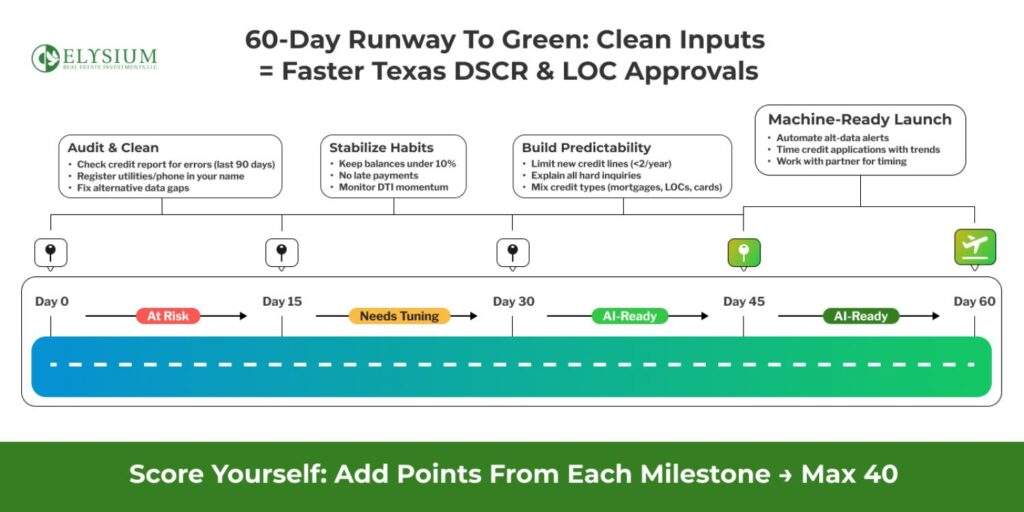
You cannot fix an AI credit profile 48 hours before a closing. You need a runway.
[ACTIONABLE TIMING]
The “Runway to Green” is a 60-day roadmap. From auditing errors in the first 15 days to stabilizing utilization under 10% by day 45, we ensure you are “Machine-Ready” before the lender pulls your file.
Technology moves fast, but trust is built face-to-face. If you are in the neighborhood, we invite you to Meet in Person at our Texas office for a relaxed conversation about your long-term goals and how to align your financing runway with your 2026 acquisitions.
Persona Playbook – How Tech-Savvy Investors Should Respond

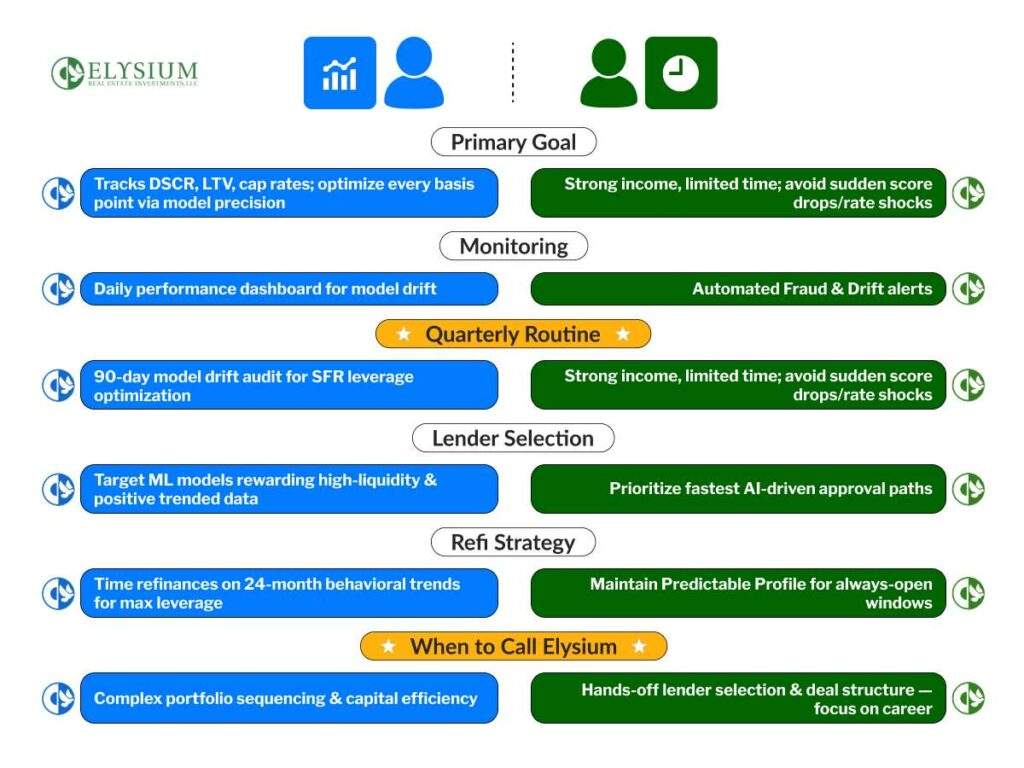
Whether you are a Data-Driven Investor or a High-Earning, Time-Poor (HETP) Professional, your governance habits must change.
[GOVERNANCE HABITS]
Maintain access through 90-day “Model Drift” audits and 15-minute “Quick Clean” routines. These habits empower you to maintain “Always-Open” windows for refinancing and acquisitions.
1. The Data-Driven Investor: Quarterly Governance
This investor tracks DSCR, LTV, and cap rates with surgical precision and is naturally curious about how risk modeling works under the hood. They understand that AI-driven credit score changes impact more than just a number; they impact leverage and the timing of refinance windows.
To win, this persona must treat their AI credit report like a live performance dashboard rather than a static paper file. By treating your credit like a live dashboard, you can stay ahead of algorithmic shifts that might otherwise compress your borrowing power. To do this, you should adopt a 90-day “model drift” audit to ensure your leverage stays optimized for Texas SFR expansion.
Quarterly Routine for Continued Access:
- Audit for “Data Drift“: Every 90 days, audit your financial technology dashboard specifically for data drift. Ensure that your spending patterns or debt structures haven’t shifted in a way that AI models might flag as risky.
- Align the Runway: Align your acquisition cadence with a strict 60-day runway. Ensure your risk modeling remains stable and utilization is optimized exactly two months before a major credit pull.
The HETP Professional: Predictability First
High-Earning, Time-Poor Professionals depend on credit cards, HELOCs, and portfolio lines of credit to move quickly on Texas deals. For them, the messaging is simple: “Protect your time by protecting your approvals.” Because artificial intelligence credit scoring can trigger sudden rate shocks or denied refis without warning, maintaining a “Machine-Ready” profile is a necessity.
Lenders favor “low-friction” files that don’t trigger manual reviews or algorithmic fraud flags. Since speed is your priority in the competitive Texas market, you need to minimize any behavioral noise in your data. Implement a 15-minute “Quick Clean” of balances before any major lender pull to prevent rate shocks that could stall your next Texas deal.
Quarterly Routine for Continued Access:
- Automate Defenses: Set automated alerts for any change to your AI credit report profile (new inquiries, balance changes, or new accounts).
- Review Utilization Spikes: Once per quarter, review your card balances to ensure high spending months aren’t resulting in “utilization spikes.” Even if you pay in full, a mid-cycle spike can be misread by algorithms as a negative behavioral trend—catch it before your lender does.
Technology moves fast, but trust is built face-to-face. If you are near our Texas headquarters, we’d be honored to have you Visit Our Office for a relaxed sit-down to ensure your financing plan serves your legacy.
How Elysium Sits Between You and the AI Credit Black Box

Whether you are scaling a 10-property portfolio or a 100-property fund, Elysium acts as the expert translator. We map lender AI criteria, stress-test deals under multiple scoring scenarios, and help structure portfolios resilient to AI-driven shifts.
To gain further insights and in-depth information, we invite you to explore our blog on rate cuts and housing demand, and how shifting borrowing costs can influence approvals and pricing. This resource provides valuable guidance for navigating investment opportunities in the state, and you can also review our guide to the top Texas investment cities to help align market selection with your financing plan.
Conclusion: Translating the "Black Box"
AI credit scoring has replaced the static report with a living, breathing data stream. In the age of AI, investors who understand how credit models see them will control their access to capital, not the other way around.
How We Help Translate the “Black Box”:
- Data Governance: We audit your profile for “Data Drift” before lenders see it.
- Algorithmic Alignment: We align your behavioral habits with the specific ML models used by Texas DSCR lenders.
The 60-Day Runway: We build the timeline that ensures your capital access is never interrupted.
Whether you prefer a Phone Call, Zoom, or In-Person Visit, our doors are always open to you. We believe the best investments start with a solid relationship; come Visit Our Office to discuss how we can protect your interests together and act as your expert translator in this new AI landscape.
Lead Magnet: Get the AI Credit Readiness Guide
“Ready to audit your profile for Data Drift? Submit Your Request for the AI Credit Readiness Guide and our team will provide your secure download link.”
Have a specific question about AI credit scoring? Submit your query to our [Elysium Q&A Page] or browse our strategy categories to see how we help Texas investors navigate Data Drift.