


Visitor Snapshot
High-net-worth investors and family offices navigating Texas residential real estate now benefit from restored privacy after a Texas federal judge vacated the FinCEN real estate rule. The March 19, 2026, ruling in Flowers Title Companies, LLC v. Bessent eliminated mandatory beneficial ownership reporting for non-financed entity and trust transactions nationwide. This creates immediate relief for structured acquisitions in Houston’s master-planned communities, the high-growth corridors of North Austin, and Dallas’s high-growth residential corridors—allowing a focus on strategic 2026 execution without prior federal compliance friction. This landscape allows investors to leverage the immediate relief from federal compliance friction, creating a streamlined environment for structured entity acquisitions in premium Dallas neighborhoods, alongside Houston and North Austin.
The landscape of American real estate investing recently faced a significant regulatory hurdle that threatened to dismantle the long-standing tradition of transactional confidentiality. However, on March 19, 2026, a Texas federal judge issued a universal vacatur of the FinCEN real estate rule, effectively halting a mandate that many in the industry viewed as a bridge too far for federal agencies. This ruling is not merely a legal technicality; it represents a comprehensive restoration of the Investor’s Right to Quiet Enjoyment and the preservation of privacy in residential deals.
For the high-net-worth individual, “quiet enjoyment” has historically referred to the right to possess and use property without interference. In the modern era, this right has expanded to include the right to deploy capital and structure assets with a level of discretion that protects both personal security and competitive advantage. The judicial intervention in Flowers Title Companies, LLC v. Bessent has reaffirmed that the government cannot bypass statutory limits to peer into the private affairs of law-abiding investors. As we navigate this post-ruling environment, the focus shifts from defensive compliance to the proactive execution of growth strategies in prime Texas markets, where privacy remains a cornerstone of institutional-grade investing.
The Ruling: A Legislative Deep Dive into Categorical Suspicion
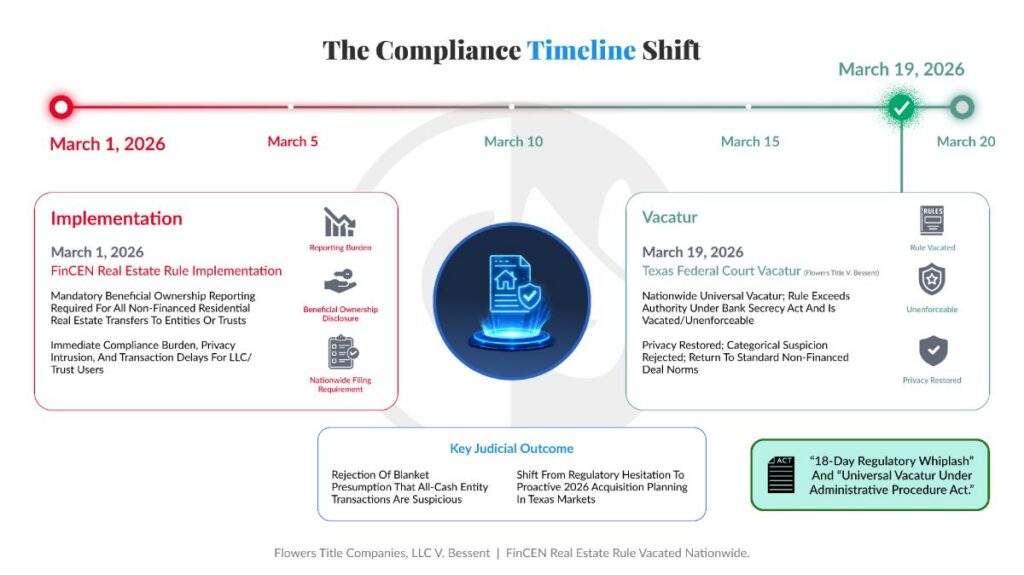
At the center of this legal battle was the fundamental question of whether the Financial Crimes Enforcement Network (FinCEN) overstepped its bounds under the Bank Secrecy Act (BSA). The FinCEN reporting rules introduced on March 1, 2026, sought to require detailed beneficial ownership information for all non-financed residential transfers to entities or trusts. This mandate was built upon a foundation that Elysium and many institutional peers found problematic: the idea that every all-cash transaction involving an LLC was inherently suspicious. This “categorical suspicion” suggested that the very act of using a standard business structure for a real estate acquisition was a proxy for illicit activity.
Judge Jeremy D. Kernodle’s decision delivered a decisive blow to this logic. The court specifically rejected the government’s attempt to impose “categorical suspicion” on all-cash transactions, noting that the Bank Secrecy Act was designed to target specific, evidence-based suspicious activity rather than entire classes of legitimate business behavior. The ruling clarified that being an all-cash buyer or using an LLC is a standard business practice, not a reason for federal surveillance. The judge highlighted that administrative agencies do not have a “blanket license” to ignore the specific constraints placed upon them by Congress. By attempting to treat every entity-based buyer as a potential money launderer, FinCEN failed to satisfy the “arbitrary and capricious” standard of the Administrative Procedure Act.

The Failure of Regulatory Logic
According to court filings, FinCEN attempted to justify the rule by citing that 42% of transactions covered by previous Geographic Targeting Orders (GTOs) were linked to individuals named in suspicious activity reports. However, the court found that this did not grant the agency the authority to create a blanket presumption of guilt for all entity-based deals. The court noted that a 42% correlation in a limited, high-risk geographic sample does not justify a 100% reporting requirement for the entire nation.
Scaling a high-risk, localized geographic sample into a 100% blanket nationwide reporting mandate was a fatal logical flaw. By treating standard residential transfers with the same suspicion applied to high-risk financial instruments, FinCEN attempted to bypass specific legislative intent. This overreach effectively penalized standard, privacy-minded entity structures that form the bedrock of legitimate wealth management, rather than focusing on the specific, illicit activity the Bank Secrecy Act was originally designed to combat. By striking down this presumption, the Flowers Title Companies, LLC v. Bessent decision has protected the privacy rights of the Privacy-Minded Entity Investor who uses these structures for liability shielding and asset protection rather than illicit purposes.
Preserving Transactional Norms
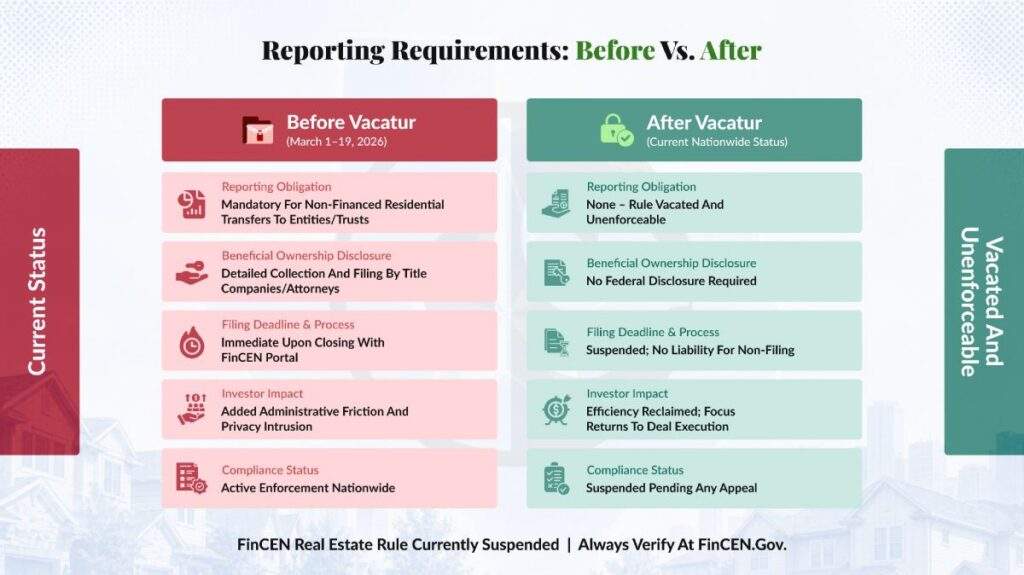
This FinCEN news update is critical because it highlights the limits of administrative power. The judge ruled that the agency exceeded its authority, making the rule Vacated and Unenforceable nationwide. This means that title companies and attorneys—the designated “reporting persons”—are currently under no federal obligation to file these intrusive reports. This FinCEN legal challenge has successfully preserved the integrity of standard non-financed deal norms, ensuring that the government cannot unilaterally redefine private commerce as a high-risk activity without legislative approval. For the investor, this means the documentation required at the closing table remains focused on the transfer of title and the verification of funds, rather than the disclosure of a personal family tree to a federal database.

As illustrated in Infographic 1: The Compliance Timeline Shift, the ruling created an 18-day window between implementation and nationwide vacatur—demonstrating decisive judicial intervention.
Restoring Privacy and Institutional Trust
The nationwide vacatur of the FinCEN real estate rule represents a critical return to principled privacy in the real estate sector. For decades, the use of entities like LLCs and trusts has been a fundamental tool for the Strategic Asset Buyer seeking to manage risk and provide for long-term wealth transfer. The vacated rule sought to pierce this corporate veil indiscriminately, a move that the Texas court recognized as a significant overreach of federal power. This is a win for institutional trust, which is built on the expectation that legal and regulatory frameworks will remain stable and predictable. When the government attempts to redefine routine investment practices as inherently suspicious, that trust is eroded.

By contrasting the “overreach” of the now-vacated rule with the principled privacy of entity-based investing, the court has safeguarded the operational flexibility that family offices and accredited investors rely on. This is especially relevant in Dallas’s premium asset zones, where privacy is often a prerequisite for high-value acquisitions. Family offices, in particular, require discretion not to hide assets, but to protect the principals of the office from public solicitation, kidnapping risks, and frivolous litigation. The Flowers Title Companies, LLC v. Bessent decision ensures that these structures can continue to fulfill their intended roles without triggering automatic federal red flags.
Protecting the Family Office Structure
Elysium Real Estate Investments views this restoration as essential for maintaining a healthy investment environment where asset protection through fundamental trusts and trust-based asset protection can be pursued without the fear of unnecessary federal data collection. The vacated rule would have required family offices to disclose the personal details of every individual with a “substantial interest” in the entity, a requirement that felt more like a fishing expedition than a targeted law enforcement tool. The court’s recognition of entity-based investing as a “standard business practice” validates the legal and financial frameworks used by the world’s most sophisticated investors.

Returning to Strategic Growth
Furthermore, the ruling allows investors to move away from “defensive compliance planning” and back toward strategic growth. Instead of spending resources on documenting the benign nature of their capital, investors can focus on strategic property selection and the power of real estate syndication and other collaborative models that drive value in the Houston market.
Reclaiming transaction efficiency allows family offices and accredited investors to move at lightning speed in our high-competition Tri-Plex asset zones. When federal reporting friction is removed, the velocity of capital deployment increases significantly, giving our investors a primary competitive edge in securing prime assets across the Houston, Austin, and Dallas corridors. The restoration of the right to quiet enjoyment means that the process of acquiring property returns to being a private transaction between willing parties, rather than a federal reporting event. This restoration of privacy is not a “loophole”; it is a return to the constitutional principle that private individuals should be free from government surveillance unless there is a specific, individualized reason for suspicion.
Transaction Privacy Review Worksheet
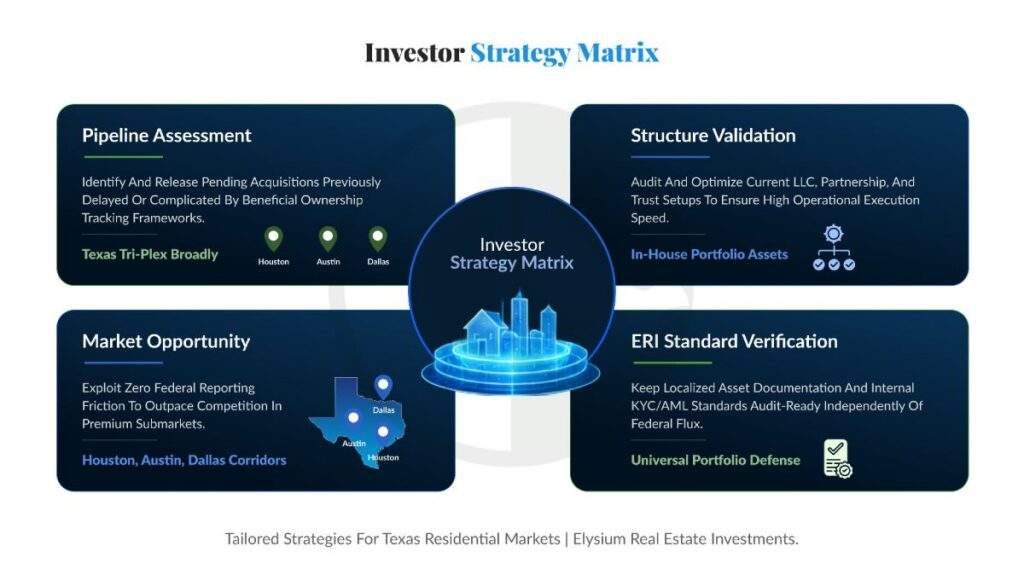
Pipeline Assessment
Identify any pending 2026 closings that were previously affected by the March 1st mandate. It is critical to ensure these transactions are now proceeding under the clarity provided by the nationwide vacatur to avoid unnecessary administrative delays.Structure Validation
Confirm your LLC or trust structures are optimized for both asset protection and the current “relief window.” This is an ideal time to ensure your privacy-minded entities are robust enough to withstand potential future shifts in the regulatory landscape.Market Opportunity
Evaluate how the removal of reporting friction affects your ability to close quickly in high-competition zones like North Austin, Houston and Dallas. With mandatory federal reporting suspended, speed of execution becomes a primary competitive advantage.Documentation Check
Ensure internal records align with institutional best practices and the ERI Standard despite the federal suspension. Maintaining rigorous internal documentation ensures your portfolio remains resilient and “audit-ready” regardless of federal mandates. Is your next residential property acquisition positioned to benefit from this ruling?or explore our Elysium Q&A for privacy-focused strategies in the current Texas market.
Compliance Outlook: The ERI Standard vs. Federal Mandates
While the FinCEN real estate rule is currently Vacated and Unenforceable nationwide, it is vital for our partners to understand that “no federal mandate” does not mean “no compliance.” At Elysium, we maintain a clear distinction between the suspended federal reporting requirements and The ERI Standard. Our internal KYC(Know Your Customer) and AML(Anti-Money Laundering) protocols remain active and robust, as they are part of our core culture, not just a response to a government mandate. We believe that true institutional stability is built on self-imposed excellence rather than external coercion.
The FinCEN court decision created what we call a “relief window” for capital deployment. However, Elysium continues to conduct thorough due diligence and verify investor qualifications to protect the integrity of our firm and the interests of our partners. We choose to maintain high-level standards because they provide a layer of security that transcends the current political or judicial climate. This proactive approach ensures that our portfolios remain resilient, regardless of whether a federal agency is actively enforcing a specific reporting rule. By differentiating our permanent, high-level protocols from the shifting federal mandates, we show our investors that we are compliant by choice and culture.

The "District Split" and Regulatory Whiplash
As the regulatory landscape enters a “strategic hold” pending potential appeals, our commitment to best-in-class compliance remains a constant. It is critical to note that while the Texas ruling has a nationwide effect, other districts—such as those in Florida and North Texas—have previously upheld different variations of reporting rules. This conflict creates the “whiplash” effect that requires a “Steady Hand” to navigate. We continue to monitor the “District Split” while leveraging the current nationwide clarity provided by the Flowers Title Companies, LLC v. Bessent ruling and our internal Texas property market insights. This balanced approach allows the Strategic Asset Buyer to scale their portfolio with the confidence that they are operating within a framework that values both privacy and institutional integrity.

Institutional Resilience Through Internal Standards
By maintaining our own AML and KYC standards, we ensure that our transactions are “audit-ready” even in a world without the vacated FinCEN rule. This level of preparation is what separates a professional real estate investment firm from a speculative venture. We view this post-vacatur period as a “relief window” for capital deployment, but we do not view it as a reason to lower our guard. Our commitment to transparency with our partners is exactly what allows us to defend their privacy from external overreach. This is the ERI Standard: protection through preparation.
As shown in Infographic 2: Reporting Requirements: Before vs. After, the shift eliminates prior burdens while maintaining best-practice standards.

Navigating the 2026 Regulatory Landscape
With the rule suspended, the focus returns to informed, structured acquisition strategies. Elysium continues to monitor developments closely, including potential appellate review, while guiding clients toward opportunities that leverage the current clarity. Strategic property selection, partnership structures, and long-term planning remain central.
To gain further insights into asset protection using trusts in Texas real estate, explore our detailed guide on fundamental trusts for real estate investors. For those interested in collaborative approaches, our overview of the power of real estate syndication offers practical strategies tailored to residential opportunities.
Building Resilience in a Shifting Environment
Elysium translates regulatory clarity into lasting advantage through ongoing support, expert guidance, and adaptable planning that balances privacy with prudence. This creates opportunities to scale residential portfolios in Texas markets with renewed focus.
Conclusion
The Texas court’s decision in Flowers Title Companies, LLC v. Bessent checked FinCEN overreach, vacated the FinCEN real estate rule nationwide, and restored investor privacy. This judicial win marks a significant transition from regulatory defense to active, strategic growth. By removing the “categorical suspicion” that once hampered all-cash and entity-based deals, the court has cleared a path for the Strategic Asset Buyer to scale their portfolio with renewed efficiency.
As we move forward into 2026, the focus for high-net-worth investors should be on leveraging this “relief window” to finalize structured acquisitions in Texas’s high-growth corridors. Whether you are focused on Houston, Austin, or Dallas, the restoration of privacy is a powerful catalyst for capital deployment. Elysium Real Estate Investments remains the steady hand guiding clients through these shifts, ensuring that every acquisition is backed by institutional expertise and a commitment to the Investor’s Right to Quiet Enjoyment.
Strategy Session Invite
Transition from regulatory defense to proactive 2026 execution. Is your next property acquisition affected by this ruling? Let’s discuss your 2026 strategy and how we can maximize your returns while maintaining the highest levels of privacy and compliance.
or explore our Elysium Q&A.