

For decades, the American dream of retirement has been built on the foundation of “mailbox money.” The allure is undeniable: tangible assets, steady cash flow, and an inherent hedge against inflation that few paper assets can match. However, a sophisticated debate is emerging among high-net-worth circles. While the long-term benefits of residential real estate are statistically superior to many alternatives, the asset class possesses a critical retirement weakness: real estate liquidity.
The Case FOR Rentals in Retirement
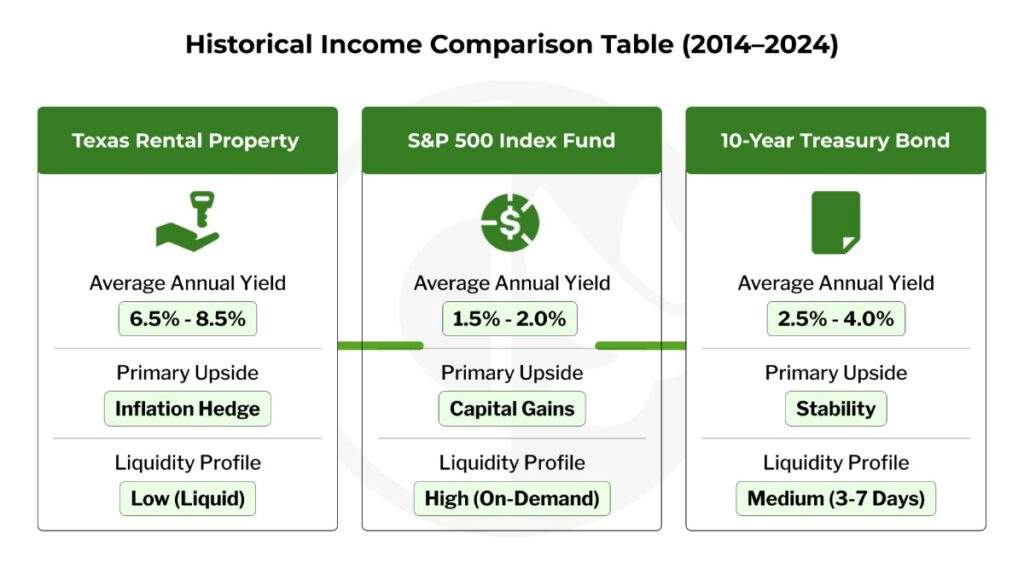
Before dissecting the liquidity flaw, we must re-affirm why rentals remain a top-tier retirement asset. Residential real estate in Texas has historically provided a yield that outpaces traditional fixed-income instruments. This makes it a cornerstone for passive real estate investment strategies for busy professionals looking for long-term security.
Cash flow that beats bonds

Appreciation that outruns inflation
Unlike fixed-income assets, residential rents and property values tend to adjust upward alongside the Consumer Price Index. This makes them an essential component of retirement planning with Texas real estate. By capturing the intrinsic utility of housing, investors ensure their purchasing power remains intact over a multi-decade retirement horizon. To sustain this growth, owners must learn how to mitigate risk while pursuing high-growth real estate investments.
The Liquidity Stress Test: Measuring Hidden Portfolio Risk
The danger of an illiquid portfolio reveals itself during the “distribution” phase. For The Early Retiree (FIRE Movement), the greatest fear is an unplanned expense—a “healthcare shock” or a major capital expenditure—that requires immediate access to six figures of capital.

Healthcare shocks and sequence-of-returns risk
Forced sales in downturns
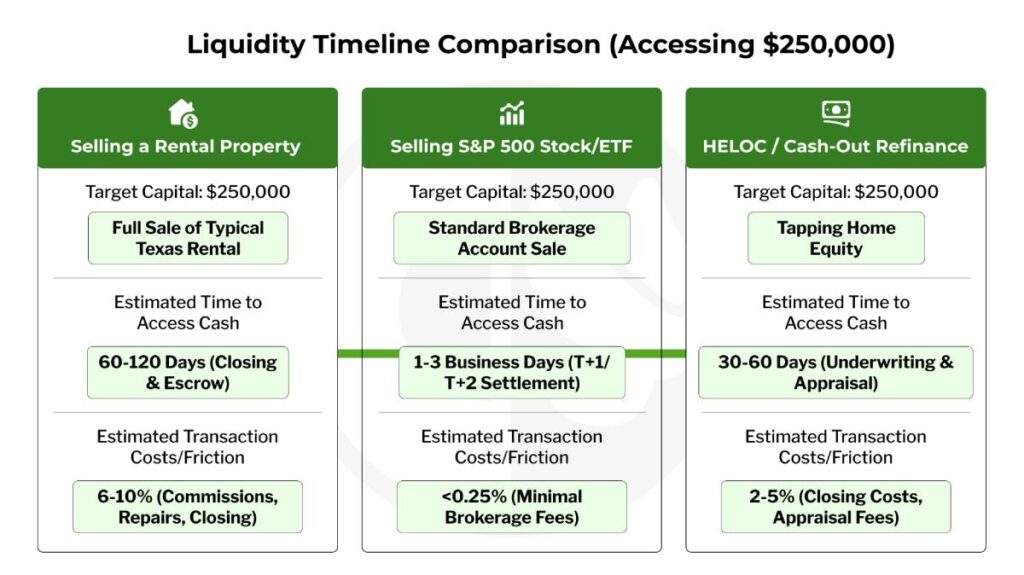
Liquidity is not just about the “ability” to sell; it is about the “cost” of selling. According to Investopedia’s definition of Liquidity Risk, the inability to meet short-term debt obligations due to the inability to convert assets into cash is a primary cause of individual financial failure. This is exacerbated by the total capital-access cycle in Texas, which currently averages between 90 and 120 days.
According to the Texas Housing Insight Report, the average time a home spends on the market has climbed to 60 days, not including the additional 30-day average for technical closing. Furthermore, this timeline is being impacted by the 2024 NAR Settlement, which introduces new mandatory negotiation steps for buyer-broker compensation that can extend the “contract-to-close” period.
The 10% Leak: Understanding Transactional Friction
Beyond time, the greatest threat to a retiree’s capital is the “friction” of a standard exit. Between broker commissions, repair credits, and closing costs, a full market sale often costs 6%–10% of the total asset value. For a $1M portfolio, that is a $100,000 penalty just to access your own money.
Rather than losing 10% to a full sale, sophisticated investors should focus on leveraging equity in investment properties to extract capital tax-efficiently. Per the 2026 TRERC Forecast, the “cost of capital” for extraction is often lower than the “cost of liquidation” when factoring in depreciation recapture and capital gains.

The Retirement Liquidity Scorecard: Your Self-Assessment Center
Net worth is a vanity metric if it cannot be deployed. Our scorecard measures the Velocity of Capital. Scoring low on specific metrics indicates a need to revisit understanding the different types of real estate financing to diversify your access points. To see how these scores translate into strategies, view our Elysium Q&A portal.
Retirement Liquidity Scorecard
Total Score: 0
Diagnosis
Recommended Action
Download Your Personalized Report

The Tax Friction of Forced Liquidity
Smarter Solutions: Keep Real Estate, Add On-Demand Liquidity

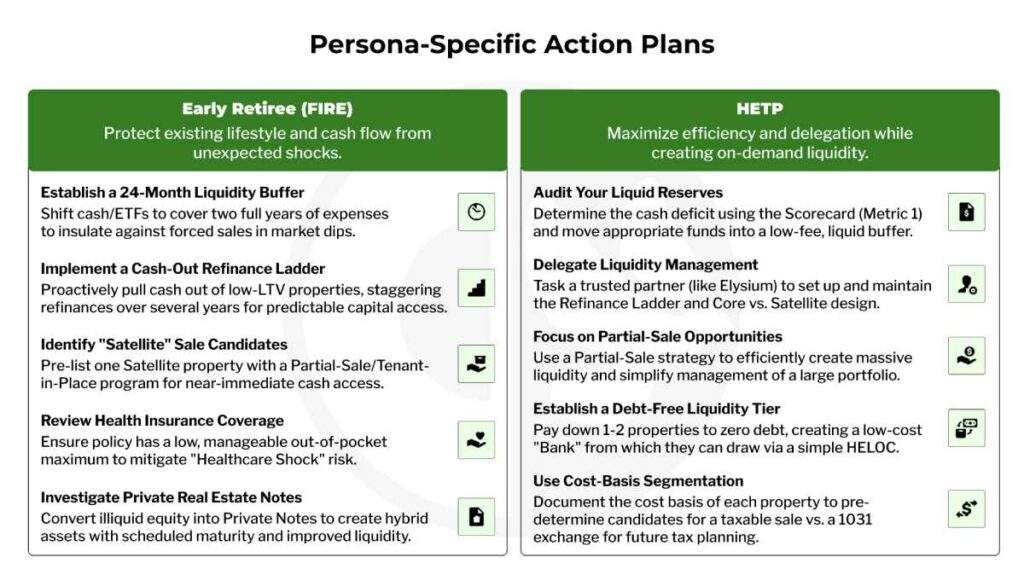
Solving the liquidity dilemma does not require abandoning the asset class. Instead, it requires a shift toward efficiency and delegation. For the High-Earning, Time-Poor Professional (HETP), the goal is simple: implement smart leverage strategies-maximizing real estate returns without excessive risk to keep the portfolio agile and responsive.
Cash-out refinance ladders
A refinance ladder involves staggering the debt cycles of your properties. By proactively pulling cash out of low-LTV (Loan-to-Value) properties during favorable rate environments, you ensure a rotating supply of liquid capital. According to the Consumer Financial Protection Bureau (CFPB), understanding your equity position is the first step in managing household debt effectively.

Core vs. Satellite Portfolio Design
The Elysium Difference: A Texas-Focused Liquidity Strategy
The standard advice for illiquidity is often “sell everything and buy REITs,” but this forces investors to sacrifice the massive tax advantages and direct control of physical property. Elysium Real Estate Investments offers a third path specifically designed for the Texas landscape.
In the high-growth corridors of North Austin, property values have appreciated so rapidly that many investors are sitting on hundreds of thousands of dollars in “dead equity” that produces no additional cash flow. Similarly, in Houston’s Energy Corridor and established residential districts, we see seasoned professionals holding properties free and clear, yet struggling to find liquid cash for new opportunities or emergencies.

Persona-Specific Action Plans
Liquidity is not an accident; it is an architectural choice. Before the next economic shift, audit your current holdings against our Scorecard. For many, consulting a Texas real estate taxes guide for retirees investors is the first step in calculating your true net liquidity. Once you understand your tax liabilities, you can begin rebalancing your “Core” versus “Satellite” properties to ensure you are never “house poor” in the middle of a golden retirement.

Conclusion: Winning the Retirement Debate
ERI Action Center
Accelerate your investment strategy by visiting the Elysium Q&A portal to select exactly which retirement and liquidity themes you would like to discuss with our team. This centralized hub allows you to download the 2026 Texas Liquidity Playbook or schedule a 20-minute virtual portfolio audit focused specifically on optimizing capital velocity. Our executive team is also available for in-person strategy meetings at our offices to discuss institutional entries into the Houston, Dallas, Austin, and San Antonio, Texas markets