

In 2026, the monetary environment has not returned to the easy-money baseline. Inflation remains a policy concern, rates are structurally higher than the post-2008 norm, and global reserve managers continue evaluating fiat currency concentration.
When the people who manage national reserves change what they hold, sophisticated investors pay attention.
Over the past four years, central banks have executed one of the largest shifts toward hard assets in modern history, buying more than 1,000 tonnes of gold annually from 2022 through 2024 and another 863 tonnes in 2025. For accredited investors and high-net-worth individuals, that behavior reinforces a hard asset investing strategy: preserving purchasing power through scarce, tangible assets.
A hard asset investing strategy for inflation protection is not about predicting the next gold move. It is about recognizing why institutions are reallocating toward assets that policy cannot easily dilute, and why residential real estate belongs in that conversation.
The same logic that pushes a central bank toward gold points toward residential real estate: both are tangible, both hold value across long monetary cycles, and one produces income while it does.
Why Central Banks Are Increasing Gold Reserves
Central banks do not chase momentum; they manage risk across decades. The focus on central bank gold reserves reflects sovereignty, diversification, and long-term stored value.
For private investors, central bank gold reserves and real estate investing trends connect through one principle: when currency purchasing power weakens, tangible assets often become more relevant.
Global Monetary Policy Shifts and Reserve Diversification
The 2026 reserve conversation is no longer only about yield. A disciplined gold vs dollar investing framework evaluates the tradeoff between fiat liquidity and hard asset resilience.
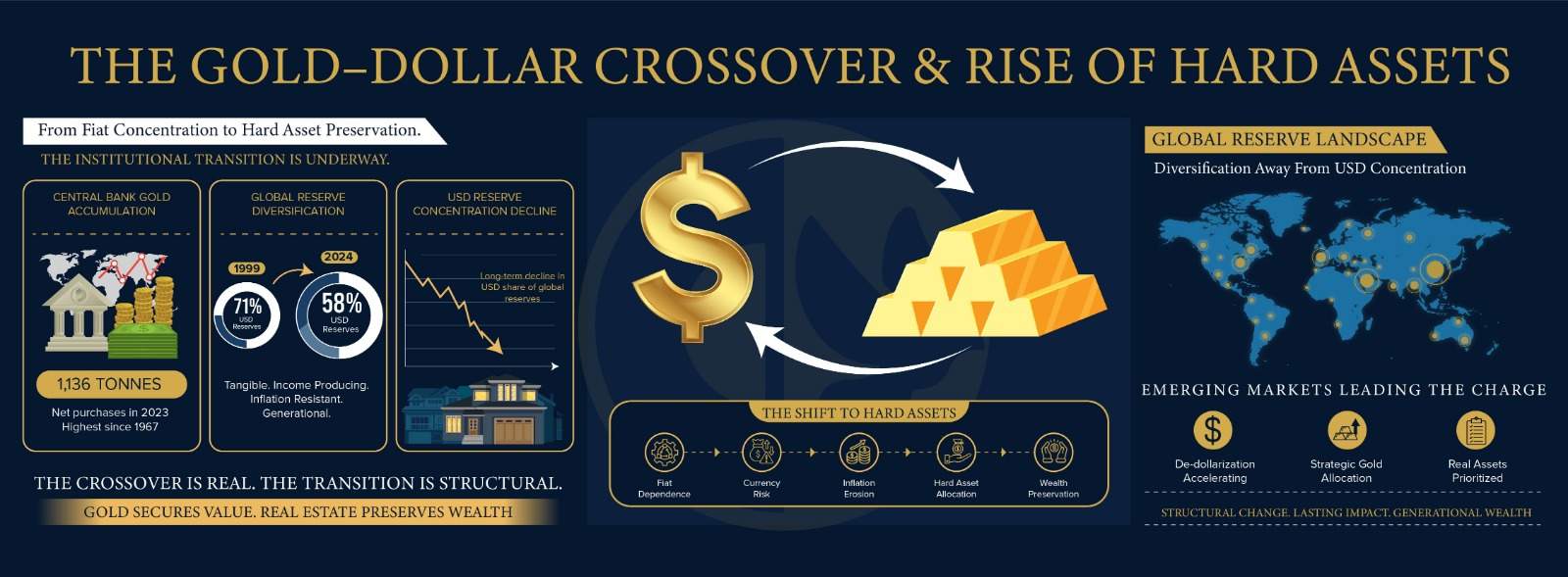
That does not mean abandoning dollar-based assets. A measured gold vs dollar investing strategy during currency debasement acknowledges that paper assets and tangible assets serve different roles when inflation, deficits, and reserve diversification shape investor behavior.
Institutional CTA — Inflation Protection Strategy Session
Qualified investors evaluating inflation protection, purchasing power preservation, and residential hard asset positioning can review how inflation-resistant residential assets may fit within a broader private portfolio. The focus is on allocation logic, not short-term market prediction. Schedule a Call →
The Long-Term Impact of Currency Debasement on Investor Confidence
Debasement refers to the reduction of a currency’s intrinsic value — historically achieved by lowering the precious metal content of coins, and in the modern era, through the expansion of the money supply beyond the growth of real economic output. As more currency units chase the same amount of goods and services, each unit buys less over time, steadily eroding purchasing power.
Currency debasement rarely arrives as a single event. It works through money supply expansion, persistent price pressure, and a gradual decline in what each currency unit buys.
For the Legacy Wealth Preserver, currency debasement investing is not speculative. It is a framework for evaluating how stored value survives across monetary regimes. A currency debasement investing strategy for high-net-worth individuals should begin with assets tied to scarcity, essential use, and durable income.
Historical Inflation Periods and Hard Asset Performance
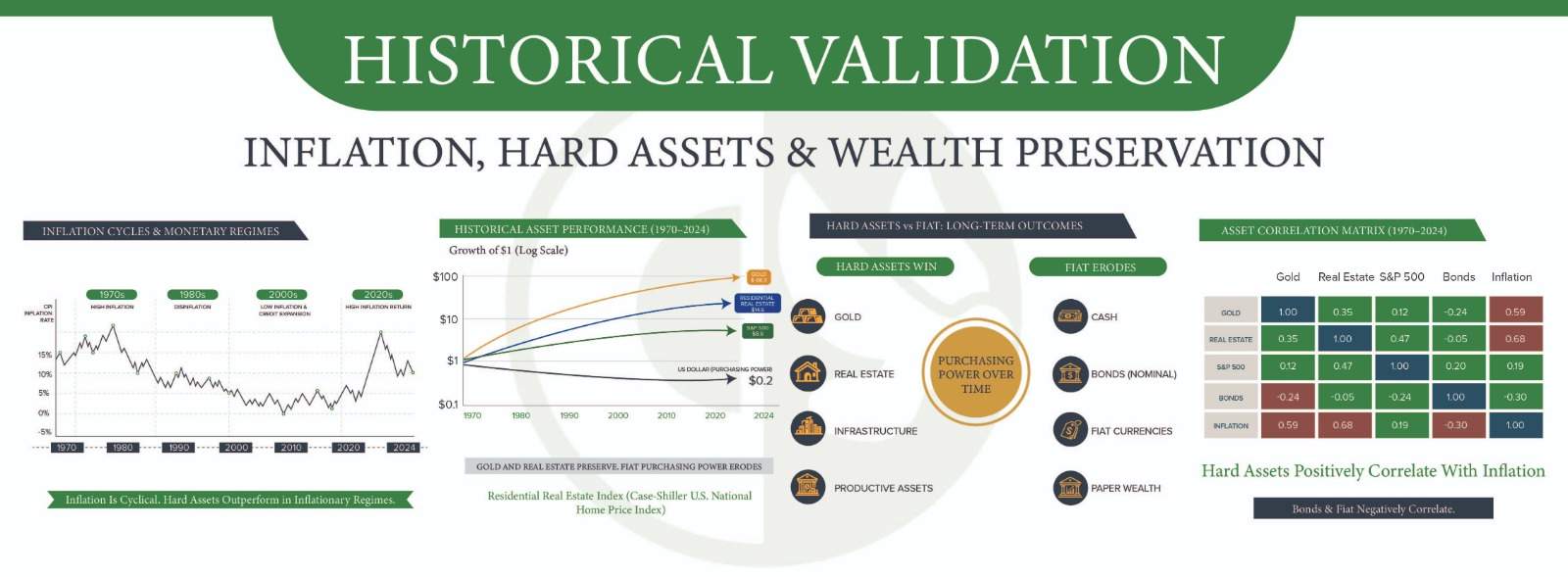
This is best understood as a hard asset during inflation cycles historical performance analysis, not a promise of future returns. The lesson is structural: scarce assets with utility are less dependent on fiat purchasing power alone.
Why Hard Assets Historically Perform During Inflationary Cycles
The inflation hedge real estate discussion starts with replacement cost and essential demand. Residential property houses people, sits on finite land, and generates rental income.
That makes residential real estate as an inflation hedge for investors distinct from non-yielding stores of value. Gold preserves value through scarcity. Residential real estate can combine scarcity with income, provided the asset, debt, and market selection are managed conservatively.
Gold, Housing, and Tangible Asset Correlation Trends
Gold is a pure store of value that pays no income. Housing is a tangible asset with recurring use. The two can complement each other inside a diversified hard asset sleeve.
Residential real estate shares the constraint, since land in high-demand metros is finite and construction cannot keep pace with population growth.
Residential real estate inflation protection comes from several channels: rents that may reset over time, property values influenced by replacement cost, and fixed-rate debt that may become lighter in real terms during inflationary periods.

Residential real estate inflation protection for accredited investors should still be framed as risk-managed exposure, not a guarantee.
Residential Real Estate as an Institutional Inflation Hedge
Residential real estate is tangible, essential, and income-producing. Unlike a commodity that sits in a vault, a rented home may generate monthly cash flow while the asset retains long-term utility.
For investors evaluating inflation-resistant investment assets,residential property offers exposure to housing demand rather than public market sentiment alone.
This is whyinflation-resistant investment assets for long-term portfolio stability often include residential hard assets alongside equities, fixed income, and cash reserves.
Income-Producing Residential Assets vs Volatile Equity Markets
Public markets can reprice quickly when rates, inflation expectations, or earnings sentiment shift. Residential cash flow rests on a more basic demand driver: people need somewhere to live across cycles.
Our analysis in Beyond the S&P 500 examines how residential assets can help steady and scale a portfolio.
Fixed-Rate Debt Advantages During Monetary Expansion
An overlooked advantage of residential real estate is how it interacts with debt. When an investor uses long-term fixed-rate debt, the payment can remain stable while rents and asset values may adjust over time with the price level.

The investor repays a fixed obligation in future dollars that may be worth less than those borrowed. Disciplined investors treat fixed-rate financing as a structural tool, not a reason for aggressive leverage.
The Role of Leverage in Inflationary Environments
Used conservatively, fixed-rate debt lets an investor control a larger asset base while inflation reduces the real weight of the loan.
The discipline lies in matching debt to durable income: a property whose rent reliably covers its fixed obligations rides out an inflationary cycle, the debt growing lighter in real terms each year. Leveraging equity in investment properties can extend that base, and our guide to smart leverage strategies covers maximizing returns without excessive risk.
Residential Leverage Strategy Consultation
Speak with the Elysium advisory team about how disciplined fixed-rate leverage may support long-term wealth preservation during monetary expansion. Schedule a Zoom Meeting →
Strategic Residential Asset Allocation for High-Net-Worth Investors
Allocation logic, not product promotion, should drive how residential real estate fits a larger portfolio. A hard asset sleeve behaves differently from equities and bonds when inflation and currency pressures rise.
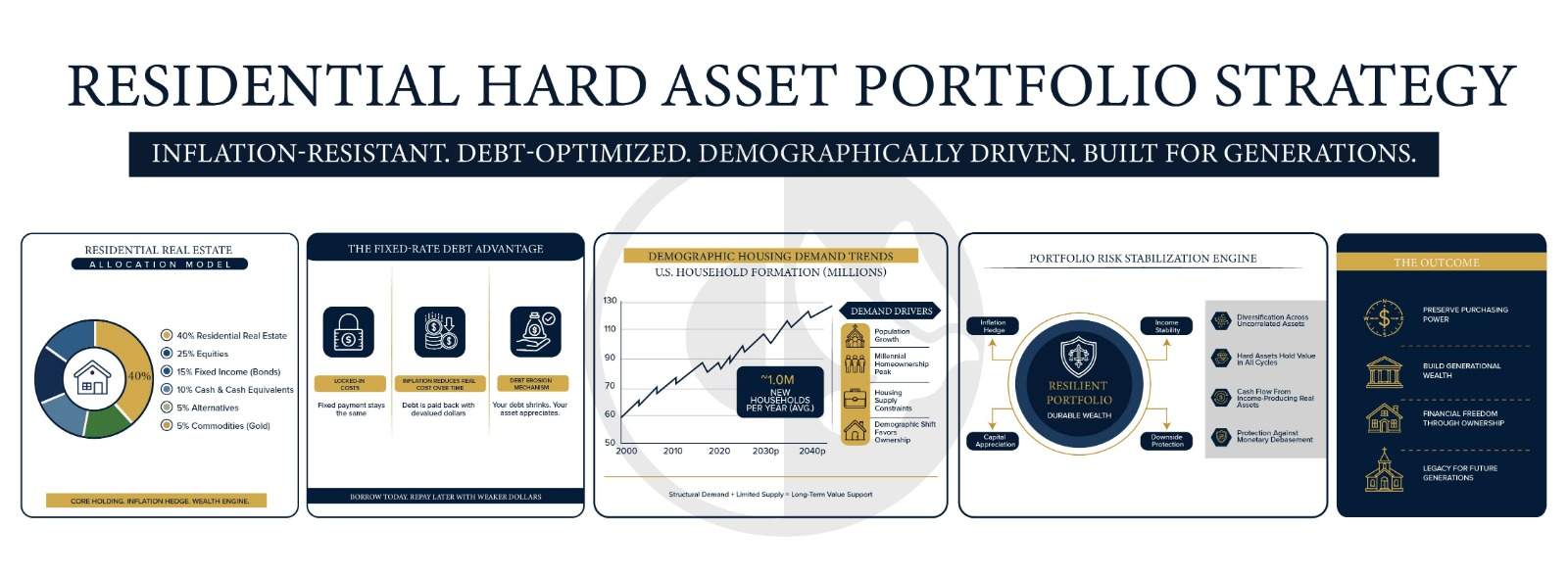
Hard asset portfolio diversification helps reduce dependence on financial assets alone. More specifically, hard asset portfolio diversification through residential real estate adds tangible ownership, recurring income, and exposure to long-term housing demand.
Housing Demand Stability and Demographic Tailwinds
National demographics anchor residential demand. Americans continue relocating to lower-cost growth regions with stronger job markets, and Texas remains a primary absorption hub.
Houston demand is supported by energy, port logistics, healthcare, and migration into Harris County, The Woodlands, Pearland, Sugar Land, and Katy.

Dallas demand follows corporate relocation, financial services growth, and job-led absorption across Plano, McKinney, Frisco, and Allen. Austin’s demand is tied to technology migration, university-linked talent, and high-income renters in Round Rock, Georgetown, and Cedar Park.
San Antonio adds living demand through Alamo Heights and Stone Oak, where healthcare, military employment, schools, and family housing needs support residential interest.
Corpus Christi extends the corridor through Portland and Flour Bluff, where port activity, energy work, and coastal living keep demand relevant.
Together, these markets reinforce Texas as a structurally important residential demand corridor.
See our residential property investment strategies for Texas investors.
Risk Management and Long-Term Portfolio Stability Through Hard Assets
Sound risk management focuses on reducing concentration and improving resilience, not chasing returns. A portfolio weighted entirely toward financial assets carries one dominant exposure: the health of paper markets and the currency they are denominated in.
Residential real estate lowers that concentration because its value rests on human need, income potential, and tangible ownershipThat does not eliminate risk, but it can improve balance..
Residential Hard Asset Allocation Consultation
For high-net-worth investors, family offices, and legacy wealth preservers, this dedicated consultation reviews residential hard asset allocation, market selection, debt structure, income durability, and portfolio risk exposure. The objective is to evaluate whether residential ownership can support long-term diversification, purchasing power preservation, and institutional portfolio stability. Meet in Person →
Portfolio Preservation Through Residential Real Estate Exposure
Residential property wealth preservation is not about short-term return chasing. It is about continuity of ownership, income, and value through changing monetary regimes.
A residential property wealth preservation strategy for legacy investors should evaluate market depth, tenant demand, financing structure, and long-term demographic support together.
Institutional Risk Mitigation Through Tangible Asset Ownership
Central banks add gold to reduce dependence on any single currency and hold a value that policy cannot directly dilute. Private investors can apply a related principle through residential real estate ownership.
The real estate as inflation hedge 2026 thesis should remain measured: residential hard assets may help protect purchasing power when paired with disciplined underwriting, conservative leverage, and market-specific demand analysis.
Real estate as an inflation hedge strategy in the 2026 monetary environment should connect tangible ownership, rental income durability, fixed-rate debt, and regional demographic growth into one institutional framework.
Real estate as an inflation hedge strategy in the 2026 monetary environment should connect tangible ownership, rental income durability, fixed-rate debt, and regional demographic growth into one institutional framework.
Conclusion
The signal from central banks is consistent and hard to ignore. They have moved toward hard assets because currency debasement erodes stored value over time.
The lesson is not to copy a central bank portfolio, but to understand the logic behind reserve diversification and apply it to residential real estate.
Begin Your Portfolio Preservation Strategy Review: Discuss how residential hard assets may support purchasing power protection and long-term portfolio stability within a diversified strategy.
Legal Disclaimer: This article is intended solely to provide macroeconomic context on currency purchasing power and residential hard asset traits for accredited investors. Elysium Real Estate Investment LLC (ERI) offerings are governed by Regulation D for accredited investors, with active 2026 exemptions consisting exclusively of Rule 504, Rule 506(b), and Rule 506(c). It does not constitute an offer to sell or a solicitation of an offer to buy any securities. This content is educational and not intended as investment advice; the content is general opinion and not financial or investment advice